Introduction
In the world of data-driven businesses, firms create huge volumes of data daily. Customer interaction, sales, operations, websites, social media activity, and other sources are continually creating useful data. But merely gathering data is not sufficient for businesses. They require intelligent software that can convert data into useful information.
This is the area where machine learning technology is changing modern business intelligence.
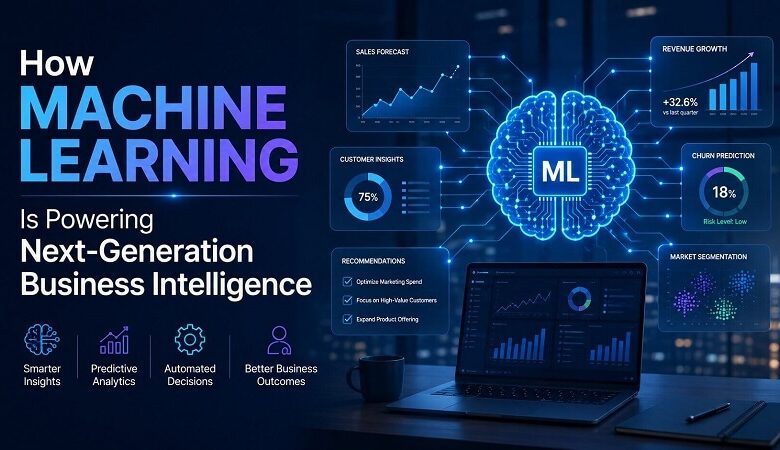
Machine learning algorithms enable organizations to identify patterns from the big data sets, make predictions based on those patterns, and make more effective and faster decisions compared to any other tool. With organizations becoming more digitally enabled and progressing through their digital journeys, the use of machine learning algorithms has become a necessity in advanced business intelligence.
In this article, we would be discussing the future of business intelligence powered by machine learning algorithms in 2026 and later.
Machine Learning in Business Intelligence
The conventional BI system had more focus on visualization of information from historical data. Even if these systems helped a lot in analyzing results, they required intervention from humans, and the systems could not forecast future events.
ML-based BI systems allow companies to do the following:
- Handle vast amounts of data
- Discover underlying patterns and trends
- Create predictive analytics
- Automate the process of report generation
As a result, organizations can make faster and more informed strategic decisions.
Predictive Analysis Ensures Smart Decisions
One of the primary advantages of machine learning lies in its predictive analytics.
By means of machine learning algorithms, one can predict what will happen in the future on the basis of the current and previous data sets.
Predictions could be about:
- The behavior of customers while buying
- Sales figures
- Product demand
- Business opportunities within the market
- Requirements of inventory in terms of volume
Using predictive analytics, companies can be prepared for future events rather than responding to past occurrences.


Benefits include:
- More accurate forecasts
- Decreased business risks
- Improved planning
- Enhanced profit margins
Real-Time Data Analysis and Insights
The business world is becoming fast-paced in nature. The need for instant availability of data cannot be overlooked by any company.
BI solutions enabled by machine learning algorithms will enable organizations to:
- Monitor business operations in real time
- Instantly detect anomalies
- Create automated alerts
- Discover new market opportunities
- Continuously monitor consumer activity
Real-time decision-making will help businesses adapt to market dynamics.
Personalized Customer Intelligence
Today’s consumers demand personalization in all digital touchpoints.
Machine learning allows businesses to know more about their customers’ preferences through:
- Purchase patterns
- Online behaviors
- Customer engagements
- Product preferences
- Consumer feedback and reviews
This enables companies to:
- Develop customized marketing strategies
- Suggest products
- Boost customer engagement
- Build customer loyalty
- Improve overall customer satisfaction
Personalization has now become an essential competitive edge for businesses.
Automated Reporting and Data Visualization
The task of business reporting has always been labor-intensive.
Machine learning technology is making business reporting more efficient through automation that can:
- Generate dashboards
- Visualize data
- Create reports
- Monitor KPIs
- Analyze performance
Automation in business reporting enables businesses to save time while offering relevant business insight to decision-makers.
Some benefits of automated business reporting are:
- Time-saving
- Low error rates
- Higher productivity
- Increased accessibility
Machine Learning Improves Risk Management
Risk Management plays a crucial role in today’s business environment.
Machine learning algorithms can scan huge volumes of data to determine the presence of risks in advance.
The ML-based BI tools enable the identification of:
– Financial risks
– Fraudulent activities
– Security risks
– Efficiency gaps
– Compliance concerns
The organization can prevent possible losses with early detection and smart monitoring.
Enhanced Operational Efficiency
Machine learning aids business in optimizing their internal operations to increase efficiency.
Some of the areas where machine learning is used are:
- Supply chain management
- Human resource management
- Allocation of resources
- Process automation
- Inventory management
- Customer services
This enables the business organizations to cut down on their costs and increase productivity.
Natural Language Processing Makes BI More Accessible
In modern times, there have been many advancements in the use of NLP in business intelligence software.
By utilizing NLP, users are able to work with business intelligence software using plain English.
Users do not need to generate complicated reports anymore; rather, they can just pose queries such as:
- What were our best-sellers last month?
- In which area did we earn the most profit?
- How much will be the expected increase in sales next quarter?
Industry Applications of Machine Learning-Powered Business Intelligence
Machine Learning is revolutionizing business intelligence across several sectors.
The use cases are as follows:
Retail
– Demand forecasting
– Inventory management
– Personalized experiences for customers
Healthcare
– Analysis of patient data
– Resource planning
– Prediction of treatment results
Banking & Finance
– Fraud detection
– Risk prediction
– Financial forecasting
Manufacturing
– Predictive maintenance
– Optimization of production process
– Supply chain analytics
Marketing
– Customer segmentation
– Analysis of campaign effectiveness
– Lead scoring
The Future of Business Intelligence with Machine Learning
With the continued advancement of AI technologies, machine learning will be further integrated into business intelligence applications.
Some potential innovations could be:
○ Autonomous decision-making algorithms
○ Machine learning-driven business decisions
○ Highly advanced predictive analytics
○ Customer insights personalized to the extreme
○ Completely automated reporting systems
Companies that adopt business intelligence applications enhanced by machine learning now will have an easier time competing in tomorrow’s data-centric world.
Conclusion
The technology of machine learning is changing the dynamics of how companies gather, analyze, and use business data. Whether for making predictions, real-time monitoring, gathering customer intelligence, or generating reports, machine learning can be of great assistance for any business.
It is no secret that digital transformation is the future of businesses, which means that the use of machine learning-powered business intelligence will only grow in importance in the coming years. Those who will succeed in adopting these innovations will enjoy a number of benefits in 2026 and beyond.