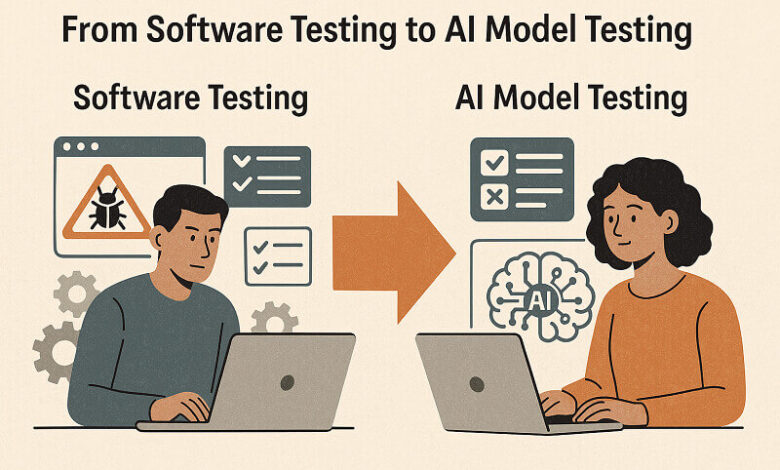
In traditional software testing, a check on the code is done with definite and established steps. However, testing the AI models requires emerging alternatives to the chance-like behaviour, data issues, and ethical issues. With AI being deployed in systems that matter, testing becomes less focused on bug detection and more focused on making general assertions about the performance, fairness and rigour of the entire model.
Conventional Software Testing Foundations
Fundamental Philosophy and Methodologies
The beginning of software testing was the manual inspection of code, and it has evolved to automated testing, such as unit tests, integration tests, and system tests. The tools developers applied included Selenium to perform browser tests and JUnit to perform back-end checks, where the results were maintained the same whenever the same input was employed. Black-box testing took no heed of what was inside. White-box testing checked the code paths.
Market Scale and Drivers
The global market in software testing is approximately USD 48.17 billion in 2025 and set to increase to USD 93.94 billion in 2030. This expansion is due to the usage of DevOps and clouds. Automated regression tests reduce the release times of companies by around 80 per cent and place testing into the pipelines of CI/CD.
- Important Metrics – defect density, pass/fail, and code coverage.
- Difficulties – unreliable tests were corrected using a retry logic, and similar environments were created using Docker.
- Success – no serious bugs in post-launch production.
It was a period of velocity and magnitude, as automation would comprise 54.5 per cent of the market by 2024.
Rise of AI‑Driven Software
Transition to the Machine Learning Systems
Neural networks are used by AI models to acquire patterns out of large data sets rather than rules. Between 2023 and 2024, most of the popular AI models were published, and the computation capacity of training increased twice every five months. Frequent tests are not applicable in such situations since AI would produce varied results for one input due to unpredictable factors during training.
The First AI Augmentation in Testing
AI assisted with testing, including autocoding self-healing scripts and identifying suspicious activity, as the 2018 system used in Keysight Eggplant generated its user paths and identified potential risks. By 2025, Artificial Intelligence (AI) enabled testing became USD 0.58 Billion (2025) at 28.7% during the CAGR 2024-2025.
Important Changes in the Testing of AI Models
Deterministic to Probabilistic Validation
Conventional testing accommodates the correct behaviour – AI security testing accommodates the statistical outcomes. New scores are accuracy, precision, recall, F1-score and AUC-ROC in the classification jobs. A model with a 95% accuracy may not work on edge cases, hence additional tests on unseen data are needed.
Information-based Over Code-based Solutions
Models are based on the quality of the training data, rather than the code. Testers are now concerned with bias, lost components, and time variation when it comes to production AI issues due to changing data. These methods are versioning data using DVC and the generation of synthetic samples.
Data validation steps –


- Test the schema of missing values.
- Statistically profile abnormal values.
- The audit bias using the auditing tools, such as AIF360.
Extended Dimensions of Testing
AI will include model cards that give limits, adversarial attack checks on data and provide explanations of the decision in SHAP or LIME. Straightforward functional tests are not sufficient, and we continue monitoring the model once it becomes operational to ensure its performance.
Resources and Systems Driving the Shift
Open‑Source Leaders
TFX executes pipelines that have built-in data and model checks. The schema changes are automatically identified in Great Expectations. Pytest can be used with PyTorch and can evaluate rapidly with the use of GPUs.
Commercial Platforms
The MLOps market achieved USD 2.33 billion in 2025 and is projected to reach USD 19.55 billion in 2032 at approximately 35.5% annually, which is powered by tools such as Weights and Biases, which demonstrate hyper-parameter tuning. UI tests on AI apps on platforms like Testim and Mabl rely on AI can also help in increasing pass rates.
Notable advancements –
- Applitools Visual AI identifies the changes in UI.
- Functionize designs natural language tests.
- Testing market that is facilitated by AI – The 2025 market value of AI-enabled testing devices is USD 0.58 billion, and it was projected that the market will expand at a rate of 28.7 per cent each year between the years 2024 and 2025.
Real Data and In-the-Field Effects
Failure Statistics
In 2024, more attention was paid to AI-related issues, as even such tests as HELM Safety demonstrated that models continue to lack reliability. A McKinsey survey conducted in 2025 claimed that 64 per cent of the companies used AI to earn money or to save money. However, only a small fraction achieved rapid progress, largely held back by inadequate testing practices.
Success Metrics
Organisations adopting MLOps report 30-50% reductions in model deployment time. Healthcare AI automation has achieved up to 70% reductions in patient verification wait times in documented cases.
Best Practices on the Transition of Teams
Build MLOps Maturity
Use GitOps models and CI/CD Kubeflow. Educate engineers in Python testing and scikit-learn metrics.
Pipeline blueprint –
- Data consumption and verification.
- Check point training models.
- Multi -metric assessment gates.
- A/B releases with canary.
- Drift detection loops.
Integrate Standards
Audit in accordance with the NIST Govern-Measure-Manage cycle. Target level 5, maturity level 1.
Foster Collaboration
Collaborate with quality engineers and data scientists. Such tools as MLflow can log all that to everyone, ensuring shared visibility, faster iteration, consistent experimentation, and smoother cross-functional alignment across teams.
Conclusion
The old method of software testing ensured functionality of the code through straightforward, foreseeable procedures, but not anymore. Quality assurance has been altered by testing AI models. We no longer check fixed, but unpredictable and data-driven behaviour. We consider performance, equity, strength and adherence. Teams should not just see bugs – the impacts they see, the bias, and the changes throughout their time. Institutions that upgrade their testing protocols and tools via MLOps, unceasing checking and AI danger plans will be more apt to roll out dependable, scalable AI systems with experts like Qualysec Technologies.