Mobile app development has undergone a massive transformation over the last decade. As businesses demand faster releases, seamless user experiences, and continuous innovation, traditional development approaches often fall short. This is where hybrid app development, combined with DevOps workflows creates a powerful advantage.
Hybrid apps, built using web technologies like HTML, CSS, and JavaScript but deployed like native apps, offer flexibility, speed, and cost-efficiency. Meanwhile, DevOps focuses on breaking silos between development and operations to ensure continuous delivery, automation, reliability, and collaboration.
When both come together, businesses can build mobile apps faster, improve quality, reduce deployment risks, and respond rapidly to user needs. For every mobile app developer, understanding this integration is becoming increasingly essential.
Let’s explore how hybrid app development aligns with DevOps workflows, the benefits it brings, and what organizations must consider for successful implementation.
Understanding Hybrid App Development
Hybrid app development allows developers to build applications using a single codebase that runs across multiple platforms, such as Android and iOS. Instead of building separate native apps for each platform, hybrid apps rely on frameworks like:
- Ionic
- React Native
- Flutter (technically a hybrid/cross-platform UI toolkit)
- Xamarin
- Apache Cordova
These frameworks allow developers to write code once and deploy everywhere, dramatically reducing development time and cost.
For businesses, hybrid apps strike the perfect balance between speed and performance. For developers, they simplify maintenance, updates, and scalability. And when combined with DevOps, the benefits multiply.
What is DevOps in the Context of Mobile Development?
DevOps represents a cultural and technological shift that integrates development (Dev) and operations (Ops) teams to streamline:
- Development cycles
- Testing processes
- Deployment pipelines
- Monitoring and maintenance
Instead of long release cycles, DevOps enables:


- Continuous Integration (CI)
- Continuous Delivery/Deployment (CD)
- Automated testing
- Rapid feedback loops
- Real-time monitoring
In mobile development, DevOps helps ensure frequent updates without compromising app stability or user experience. This is particularly useful for hybrid apps, which already support faster development cycles.
Why Hybrid App Development Fits Perfectly With DevOps?
Hybrid app development and DevOps share a common purpose: speed, efficiency, collaboration, and continuous improvement.
Here’s why they align naturally:
-
Single Codebase Supports Faster DevOps Pipelines
A key challenge in mobile development is managing separate codebases for iOS and Android. Hybrid development eliminates this complexity with a single shared codebase.
This makes DevOps workflows simpler because:
- CI/CD pipelines only need to support one codebase
- Fewer compatibility conflicts occur
- Testing cycles are faster
- Build and deployment automation becomes easier
For a mobile app developer, this means fewer repetitive tasks and more focus on innovation.
-
Automation Works Exceptionally Well With Hybrid Apps
Automation is the heart of DevOps.
Hybrid apps integrate smoothly with automated DevOps tools for:
- Code integration
- Testing
- Build generation
- Deployment
Popular CI/CD tools like Jenkins, GitHub Actions, GitLab CI, Bitrise, and Azure DevOps can easily automate hybrid app pipelines.
Automating tasks ensures:
- Faster delivery
- Fewer human errors
- Consistent builds
- Reliable releases
And since hybrid apps don’t require two separate native development pipelines, automation becomes far more efficient.
-
Continuous Testing Improves App Reliability
Testing is a critical step in mobile development. Bugs, performance issues, or UI inconsistencies can severely impact user experience.
Hybrid app development simplifies testing integration with DevOps, enabling:
- Unit testing
- Functional testing
- UI testing
- Performance testing
- Security testing
Tools like Appium, Selenium, Detox, Cypress, and BrowserStack automate cross-platform testing environments.
Hybrid apps benefit greatly because automated tests validate behavior across platforms simultaneously, ensuring consistency without double effort. This leads to more polished apps and fewer crashes when users install them.
-
Faster Releases and Updates With Continuous Delivery
One of the strongest advantages of hybrid app development is rapid iteration.
DevOps enhances this by enabling:
- Continuous delivery pipelines
- Automated build creation
- Seamless rollout of updates
Hybrid apps allow quick UI changes or feature enhancements without rebuilding apps from scratch. Combined with DevOps, businesses can push updates faster, whether they involve performance improvements, UI enhancements, or security patches.
This is especially valuable in industries where change is constant, such as eCommerce, fintech, education, and healthcare.
-
Real-Time Monitoring Enhances Performance and User Experience
Launching an app is only the beginning. Monitoring performance, crashes, and user behavior is critical.
DevOps ensures effective monitoring through tools such as:
- Firebase Crashlytics
- New Relic
- Datadog
- AppDynamics
- Splunk
Hybrid apps integrate well with monitoring systems, helping teams track:
- Load times
- Crash reports
- API failures
- User engagement metrics
- Device compatibility issues
This real-time visibility helps businesses and mobile app developers make data-driven improvements continuously.
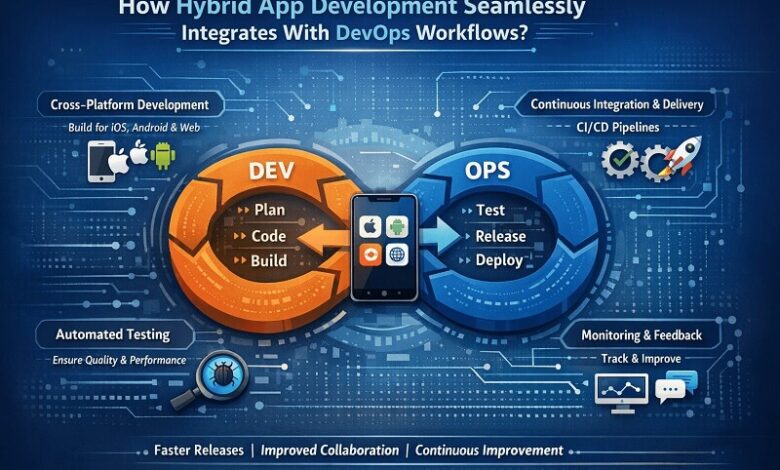
How Do DevOps Stages Align With Hybrid App Development?
Let’s break down how DevOps stages integrate into hybrid app development workflows.
🔹 Planning & Collaboration
The journey begins with planning. Teams identify:
- App objectives
- Features
- Platforms
- Performance expectations
- Security requirements
Hybrid development simplifies planning because the focus is on one unified architecture rather than multiple native strategies. DevOps enhances collaboration using tools like Jira, Azure Boards, or Trello to keep teams aligned.
🔹 Development
Developers write code using frameworks like Ionic, React Native, or Flutter. Version control tools such as Git ensure smooth collaboration.
Here, DevOps supports:
- Code reviews
- Branching strategies
- Code merging automation
Hybrid frameworks speed up development, while DevOps keeps it organized and controlled.
🔹 Continuous Integration
Whenever code changes are committed, CI tools automatically:
- Scan code quality
- Identify conflicts
- Run automated tests
- Generate builds
This ensures stable, production-ready code at all times.
🔹 Continuous Testing
Automated testing ensures hybrid apps:
- Perform consistently across Android and iOS
- Deliver smooth UI experiences
- Protect data securely
Testing becomes more efficient because hybrid apps require fewer environment-specific test variations.
🔹 Deployment & Release
Hybrid apps integrate smoothly into CD pipelines to publish apps into:
- Google Play Store
- Apple App Store
- Enterprise app distribution platforms
Automating deployment reduces release stress and accelerates time-to-market.
🔹 Monitoring & Feedback
After release, DevOps tools track performance and identify issues in real time. Teams receive actionable insights to refine features, fix issues, and enhance engagement.
This continuous improvement loop is exactly what modern businesses need.
Benefits of Integrating DevOps With Hybrid App Development
Organizations adopting this approach gain several strategic advantages:
- Reduced development costs
- Faster time-to-market
- Higher-quality apps
- Fewer failures during deployment
- Better collaboration between teams
- Scalable and future-proof development process
For businesses, this means stronger competitiveness. For every mobile app developer, it means smarter workflows and better productivity.
Challenges:
Although the integration is powerful, businesses should address certain challenges:
- Ensuring security within automated pipelines
- Managing app store approvals dynamically
- Handling platform-specific performance tuning
- Training teams on DevOps tools and best practices
Working with experienced hybrid developers and DevOps engineers helps overcome these challenges effectively.
Final Thoughts
Hybrid app development and DevOps are not just technological trends; they are strategic enablers for modern businesses. When combined, they create a development ecosystem that supports speed, quality, collaboration, reliability, and continuous innovation.
For organizations looking to build powerful, scalable mobile applications, adopting hybrid app development within DevOps workflows is a smart move. And for every mobile app developer, mastering this integration is key to staying relevant in today’s competitive digital world.