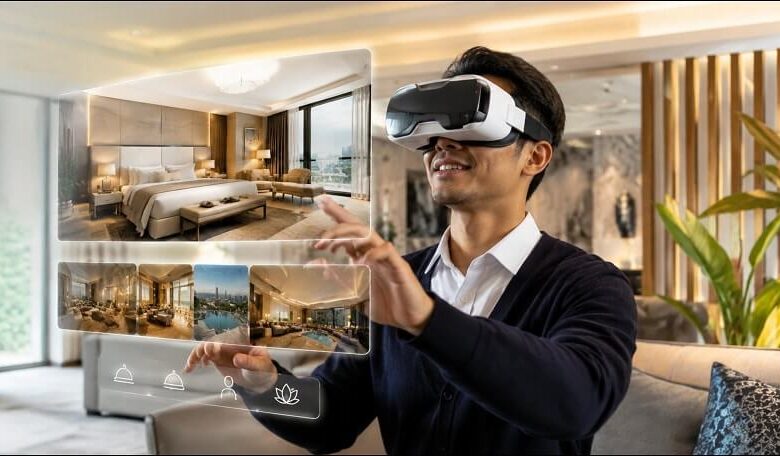
Augmented reality is no longer reserved for impressive trade show demonstrations. Companies use augmented reality to help customers visualize products, help workers perform complex tasks, optimize warehouse management, and train employees. By overlaying digital information on real-world settings, AR enables better comprehension of products, space, and processes.
The rise of augmented reality in modern businesses is indicative of increased interactivity and practicality of modern digital solutions. Retailers can offer customers a way to see how furniture will look in their home, manufacturers can provide visual instructions to assembly workers, and maintenance personnel can have access to technical information while inspecting equipment.
In this guide, we are going to talk about ten uses of AR in various businesses, together with examples, benefits, challenges of implementation, and steps to select the right solution.
How Businesses Use Augmented Reality
In general, AR is implemented in businesses in one of three categories: customer experience, workforce support, and planning/design. Each one addresses a unique challenge based on the objectives and users of the technology.
- Customer experience: Companies use AR technology to allow customers to virtually experience the product, explore its features, and participate in digital marketing campaigns.
- Workforce support: Production, logistics, and maintenance specialists use AR visuals and overlays to complete the job.
- Planning and design: Designers and engineers use AR to review digital models in actual surroundings before performing any real-life modifications.
As these examples show, augmented reality for business can enhance both customer experience and daily processes. The best solution would depend on what problem the business wants to address.
10 Business Uses of Augmented Reality at a Glance
| Use case | Common business application |
| Product visualisation | Previewing furniture, products and finishes |
| Product design | Reviewing digital prototypes in physical spaces |
| Manufacturing | Following visual assembly instructions |
| Maintenance | Accessing equipment information and remote guidance |
| Warehouse operations | Supporting picking and inventory tasks |
| Employee training | Practising procedures in interactive environments |
| Healthcare | Supporting medical visualisation and training |
| Marketing | Creating interactive brand campaigns |
| Product demonstrations | Explaining product features through digital overlays |
| Navigation | Providing location-based directions and information |
1. Product Visualization and Virtual Try-Ons in Retail
Product visualization is one of the most widely known applications of AR technology. The customer can use his or her smartphone or tablet to visualize how the product will look in the environment prior to purchasing it. Such an application works especially well for those products that depend heavily on factors such as appearance, size, or fit.
In particular, furniture stores may use AR technology for placing a virtual sofa, table, or wardrobe in the chosen room. The customer will be able to visualize the approximate size, location, and appearance of the product without physically moving furniture. Moreover, beauty and fashion companies may offer virtual try-ons of makeup, glasses, shoes, or accessories.
The experience offered by IKEA for AR-based product visualization is one of the best examples of such solutions. It allows customers to visualize how the selected furniture will fit in their homes.
This example shows how retailers can use augmented reality solutions for business to make online shopping interactive and help consumers make more informed decisions.


2. Product Design and Prototyping with AR
When designing a product, there is usually a process of reviewing several designs, measuring, and modifying them before the actual manufacturing takes place. The design team may use AR to view digital models in the real environment.
Instead of viewing the design of the product on the screen, the entire team can view the digital model in its actual size. The team will be able to see the appearance of the object and its relationship with other things around it.
The design team from the automotive sector will be able to see how the particular component will fit into the vehicle, whereas the design team at an industrial equipment manufacturer will be able to examine the digital model of the machine in a factory setting.
3. AR-Guided Manufacturing and Assembly
The process of manufacturing involves providing the employee with instructions along with different components for assembly that need to be performed in a certain order. AR technology can overlay visual instructions on the equipment or work environment so that the person knows what they are supposed to do.
With the help of the AR headset or tablet, the user can see the arrows, markings, highlights of different components, and instructions. Thus, the worker does not need to constantly look at a printed instruction manual, as all necessary information is provided using visual cues.
AR can be used in such areas as automotive manufacturing, electronics manufacturing, and machine assembly.
The AR system must be effective, as the accuracy of both the instructions and the digital overlay is crucial. Also, the process should fit the current business process workflow. The system should be tested by real workers and on real equipment.
4. Equipment maintenance and remote assistance
In the process of inspection or maintenance of equipment, maintenance workers may require technical information. The use of AR can provide such information in the form of instructions, drawings, and other details concerning the equipment directly in the field of view of the worker.
For instance, an inspector can scan the machine using a tablet, and then see the labels indicating particular parts. The expert from another place can also see the view of the technician and give him or her instructions with the help of marking some parts of the machine or pointing to a connection point.
The use of remote assistance technology by Henkel is one of the examples of such applications of AR technology for the needs of field and maintenance workers.
These applications can facilitate the work of maintenance workers, providing access to required information without constantly looking at the equipment and documents.
5. Warehouse management and logistics
There are different activities related to warehouses, such as product locating, picking orders, stock verification, and product movement. AR can help with all those activities by showing the necessary information via the head-mounted display or a mobile device.
For instance, an employee will be able to see where to go to take a product and how many items are needed to fulfill the order. It is possible that one will not have to consult paper documents or mobile screens frequently.
DHL Supply Chain tested augmented reality-assisted picking with the help of such technologies as TeamViewer Frontline Pick. According to vendor reports, the outcomes of implementation for about 1,500 operators were the following: 15% productivity improvement, an error rate of 0.1%, and a 50-70% reduction in onboarding time.
All these statistics are valid only for a particular implementation and cannot be considered universal results for all warehouses.
6. Employee Training and Workplace Learning
Conventional approaches to employee training involve presentations, manuals, and demonstrations. This way of training allows explaining a procedure, but it does not necessarily provide employees with a sufficient amount of practice time.
Augmented Reality training makes the process of learning at work more interactive, adding virtual instructions and visual cues to the real world. This way, employees can practice a task using visual cues and the actual machine or workplace they will need to operate.
So, for instance, a new technician will be able to follow a series of AR-guided instructions that will show how to examine a machine. A warehouse worker can learn how to recognize products and execute picking orders based on visual cues.
Such a method can be applied to onboarding, equipment training, safety procedures, and technical learning, but it should always be designed taking into account accurate instructions and reviewed by a subject matter expert.
7. Healthcare Visualisation and Medical Training
Healthcare practitioners have to deal with complicated anatomic structures and medical data. AR could contribute to some of this data becoming more visual by adding digital images and information on top of the real-world scene.
Within the process of education, medical students would have the opportunity to visualize anatomical structures and learn how they connect to each other. AR-based visualisation could also be used in specific clinical and planning environments to aid healthcare practitioners in analysing patient-related information.
The technology has to be applied as an auxiliary solution rather than as a substitute for professional expertise, clinically proven medical devices, and procedures. Patient privacy and data security are also important aspects to take into account.
8. AR-Powered Marketing and Advertising Campaigns
One way brands can leverage AR technology for advertising would be to run campaigns that encourage customer engagement rather than passive consumption of an advertisement. Such campaigns can involve scanning a printed image, interacting with a product model, or accessing a digital experience via the camera on one’s smartphone.
A notable example of a brand using AR in its advertising campaign was that of Pepsi Max in London in 2014. Here, the company ran a digital display to simulate a series of surprising incidents occurring in the streets surrounding the bus shelter.
Brands could replicate this kind of experience for product launches, packaging events, or social media advertising campaigns. Nevertheless, any such campaign would be judged based on relevant metrics such as interaction and conversion rate.
9. Interactive Customer Experience and Product Demonstrations
In some cases, products might be complicated enough to require visual assistance beyond mere images and descriptions. Augmented reality will allow customers to see the product through digital content.
For instance, while examining an appliance, one could see labels for the parts and features of that product. A machinery supplier could demonstrate certain components and their functionality without needing to transport the whole physical piece to each sale.
These experiences could help sales representatives describe their complicated products to customers who lack expertise. Using visuals and interactive content could be much more helpful than pure verbal description.
10. AR Navigation & Location-Based Experiences
AR navigation uses location data and digital instructions as well as visual indicators. It can assist users in understanding where to go via visual indicators overlaying the live video feed.
The technology can be used in business environments that occupy large buildings such as shopping malls, airports, museums, universities, factories, etc. Users can use visual guidance to find a certain area or an object in the facility.
In addition, AR technology can help users obtain information regarding nearby objects or points of interest. For instance, a person visiting a museum can point their device at a certain exhibit to receive additional information.
This experience is based on precise mapping and location tracking as well as clear visual guidance. At the same time, businesses need to take into account accessibility issues related to AR navigation.
Benefits of Augmented Reality in Business
The value of augmented reality for business is determined by its impact on particular operations. When applied to address a specific business requirement, AR may provide the following advantages:
- Enhanced understanding of a product or its features: customers can see how products look before buying them.
- More engaging interaction: AR provides customers and employees with a practical way to interact with digital information.
- Guidance in visual form: workers have access to guidelines and information when completing tasks.
- Trying procedures out: AR provides employees with a way to learn procedures via experience.
- Better communication: remote experts can visually help people in other locations.
- Improved decision-making: teams can evaluate digital models in a real environment without changing anything physically.
Of course, the results depend on the use case, quality of the project implementation, and usage of the technology. It is recommended that businesses set particular goals before embarking on any AR initiative.
Challenges of Implementing Augmented Reality
Even though augmented reality solutions for business are versatile enough to be implemented in any process, the implementation itself requires preparation. Businesses should take into account the following challenges before implementing an AR solution.
- Implementation costs: The costs will depend on the complexity of the experience, 3D assets, devices, integration, and future maintenance.
- Hardware compatibility: AR apps might behave differently depending on whether they are used on smartphones, tablets, or headsets.
- Monitoring accuracy: Inaccurate monitoring and positioning of digital objects may result in a poor user experience.
- Security issues: An enterprise application may handle private customer and operational data.
- Employee engagement: Employees will require appropriate training and motivation to adopt the technology.
- Digital materials update: New business practices will change instructions and product information.
A trial can be conducted to anticipate these issues.
Choosing the Right AR Device
The selection of the device must be in alignment with the task, environment, and individuals using the application. The use of smartphones or tablets may be an option for client interactions, product visualization, and employee training.
For applications requiring hands-free instructions for employees, consider using head-mounted displays. But it is important to consider factors such as comfort, battery life, field of view, ruggedness, and safety compliance.
There is no device that will be right for all AR applications. It is important to try out the application in a real-world setting and get feedback from target users.
How to Get Started with Augmented Reality in Business
To successfully apply AR, one needs to start with a business challenge, not a technological trend. There are certain steps that companies may follow to find the right application for AR and implement it properly.
- Identify the problem to solve: Is it visualization, training, maintenance, navigation, or any other task of the company?
- Set measurable goals: Think of the metrics that could demonstrate successful work, like reducing the number of picking errors, faster task completion, better interaction with customers, etc.
- Choose the application: Find out in which area AR could bring benefits over other approaches.
- Choose the device: It is important to compare devices such as smartphones, tablets, and headsets, considering the workplace and user needs.
- Plan the experience: Define all 3D objects, interactions, instructions, and integrations.
- Create a pilot: Start with the basic application and test it in practice using real users’ feedback.
- Measuring and improvements: Analyze results considering initial goals and make necessary adjustments.
Such an approach will help businesses analyze augmented reality in business based on practical results, not on their presumptions.
Common Mistakes to Avoid When Implementing AR
Some common mistakes that can hamper an AR project’s effectiveness and usability include the following:
- Failing to determine the goal at the outset: A purely technological project cannot solve a specific business problem.
- Paying no attention to the end user: The experience has to be tailored to the needs and abilities of the target audience, taking into account their working environment and technology.
- Making the experience overly complicated: A large number of animations, explanations, or interactions can interfere with the completion of the primary goal.
- Not testing the app in the real world: It has to be thoroughly checked using actual hardware, lighting, equipment, and end users.
- Not thinking about future maintenance: Product models, explanations, and integrations may need to be regularly updated.
Avoiding these mistakes will ensure successful development of business-oriented AR applications.
Working with an AR Development Partner
The development of the AR application not only includes the creation of 3D visuals. The developers need to know the process workflow, the abilities of devices, and the requirements and limitations of the environment.
The right development partner should be able to analyze the use case, recommend the right technologies, create/optimise 3D assets, develop the application, and test it on necessary devices. The developers need to describe how maintenance and updates will be handled after the launch.
Companies considering augmented reality development services should assess their project experience, technical skills, development process, and maintenance after the project is completed. It is also necessary to discuss data protection, intellectual property rights, integration, and project milestones at the stage of development.
The right partner is focused on the development of an application that will be useful for the achievement of some business goals and not just on the visual presentation of it.
Conclusion
Augmented Reality in Modern Businesses is transforming how companies interact with customers, support employees, and manage everyday operations. From product visualization and virtual try-ons to manufacturing, warehouse management, healthcare, and employee training, AR offers practical ways to improve business processes. However, successful implementation depends on choosing the right use case, technology, and devices while considering user requirements and long-term maintenance. Businesses should begin with clear objectives and test solutions before expanding them across operations. With the right approach and reliable augmented reality development services, companies can create meaningful AR experiences, improve operational efficiency, and deliver more engaging customer interactions.